How to Apply for FAA Part 107 Waivers for Specialized Operations
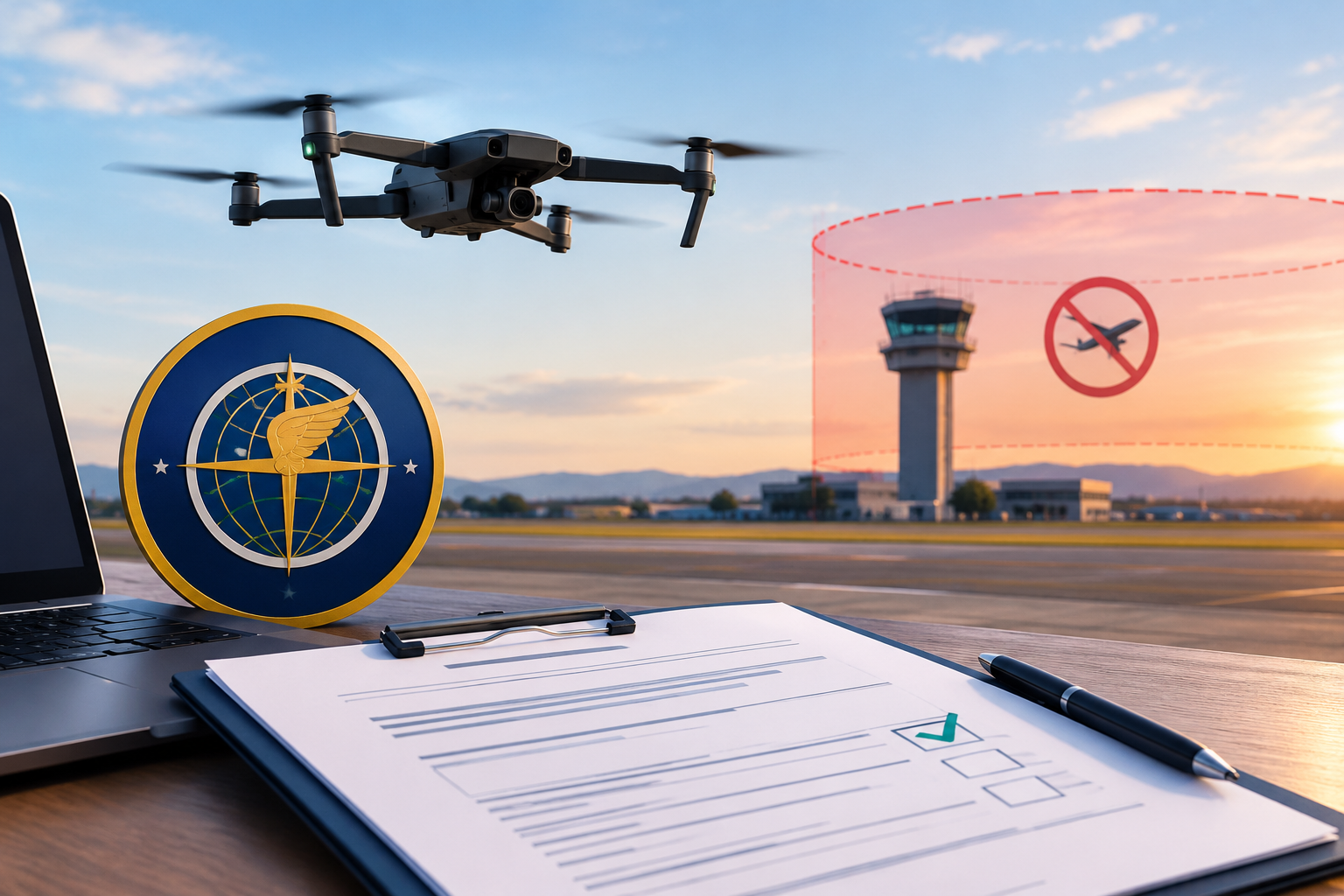
Part 107 covers the vast majority of commercial drone work, but some projects simply do not fit inside its limits. An inspection that requires flying beyond visual line of sight, a shoot that calls for operating from a moving vehicle, a mapping job with multiple drones under one pilot, or flight over people with an aircraft that does not qualify for any category. That is what waivers are for: a document the FAA issues allowing you to deviate from a specific Part 107 rule under specific conditions.
In this article I explain exactly what a waiver is, how it differs from an airspace authorization and from a formal exemption, which sections can be waived under 107.205, how to submit an application through FAA DroneZone, and how I approach an application so it has a real chance of approval. It is a process that takes time and rigor, but with the right approach it is well within reach for an independent pilot.
Waivers, Authorizations, and Exemptions Are Not the Same Thing
People use these terms loosely, but under FAA regulations they mean different things. A Part 107 waiver relieves you from a specific Part 107 operating rule and is issued under 107.200 when you show the operation can be conducted safely. An airspace authorization, governed by 107.41, is permission to fly in controlled airspace, and you get it through LAANC or DroneZone. An exemption is a separate legal mechanism, filed as a petition under Part 11 or under 49 U.S.C. 44807, and it typically applies to operations outside Part 107, such as aircraft weighing 55 pounds or more.
The distinction matters because each process has its own channel and requirements. If what you need is to fly near an airport in Class B, C, D, or surface Class E airspace, you do not need a waiver. You need an airspace authorization, and in most cases LAANC gets you one in minutes. I already have a dedicated LAANC article, so here I focus on operational waivers.
Night flying is another source of confusion. Until April 2021 you needed a waiver to fly at night. Not anymore: you can fly at night under Part 107 if your aeronautical knowledge is current and your aircraft has anti-collision lighting visible for 3 statute miles, as I explain in my night flight article. You would only need a waiver to fly at night without meeting the lighting requirement in 107.29.
Which Rules Can Be Waived Under 107.205
Section 107.205 lists the Part 107 rules that are eligible for a waiver. Only those can be waived this way; for anything else, the answer is no or you need a different mechanism. The list has changed with rule updates, so always check the current text on eCFR. As of now it includes, among others:
- 107.25. Operation from a moving vehicle or aircraft.
- 107.29. Parts of the anti-collision lighting requirements for night and civil twilight operations.
- 107.31. Visual line of sight, the basis for BVLOS operations.
- 107.33. Visual observer requirements.
- 107.35. Operation of multiple small UAS by one pilot.
- 107.37(a). Yielding the right of way.
- 107.39. Operation over people outside the Subpart D categories.
- 107.51. Limits on groundspeed, maximum altitude, visibility, and cloud clearance.
- Subpart D. Several sections covering operations over people and moving vehicles, including 107.145.
Some rules are not on that list and therefore cannot be waived with a Part 107 waiver. Carrying hazardous materials is a clear example. There is also no waiver that lets you operate in a careless or reckless manner. If your project hinges on one of those rules, a waiver is not the path, and you should rethink the operation or talk to an aviation regulatory specialist.
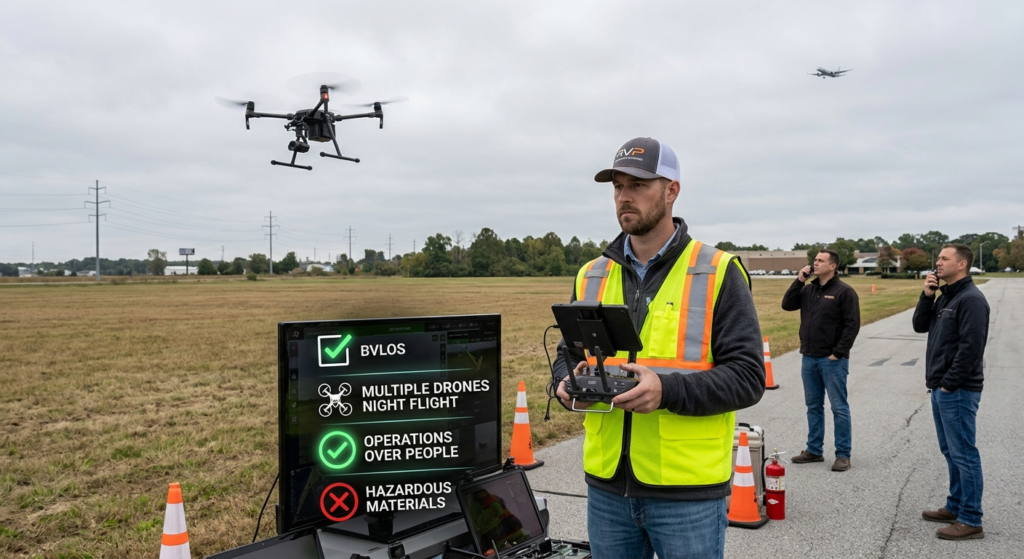
The Most Requested Waivers and What the FAA Wants to See
Beyond Visual Line of Sight (107.31)
The BVLOS waiver is probably the most sought after and the hardest to get. The FAA needs to see how you will detect and avoid other aircraft without seeing them directly, how you will maintain the command-and-control link, what happens if it drops, and how you will keep the aircraft from flying over people or outside the planned area. Successful approaches usually combine observers, detection systems, defined operating areas, and very detailed contingency procedures. The FAA has also proposed a dedicated BVLOS rule (Part 108); check its current status on faa.gov, since it could change how these operations are handled.
Altitude and Moving-Vehicle Operations
Waivers of 107.51 to exceed 400 feet AGL are requested, for example, to inspect tall structures that fall outside the 400-foot structure allowance. Waivers of 107.25 allow operation from a moving vehicle in sparsely populated areas or under controlled conditions, which is useful for film work and linear inspections. In both cases the FAA wants to see how you manage risk to other aircraft and to people on the ground.
Multiple Aircraft and Operations Over People
Waivers of 107.35 let a single pilot operate more than one aircraft at a time, which is common in light shows and some mapping work. Waivers of 107.39 and Subpart D cover flight over people with aircraft that do not qualify for any category. Here the FAA pays close attention to aircraft design, reliability history, safety systems such as parachutes, and how the operating area is controlled.
How to Submit Your Application in FAA DroneZone
Waiver applications are submitted online through FAA DroneZone under the Part 107 section. You need an account with your pilot information, and in the application you identify which sections you want waived, describe the operation, and answer the safety questions the FAA has defined for each rule. The FAA publishes Waiver Safety Explanation Guidelines that spell out what it expects for each regulation. Read them before you start.
- Define the operation precisely: what, where, when, with which aircraft, and with which crew.
- Identify the exact section you need waived and confirm it appears in 107.205.
- Read the FAA’s safety explanation guidelines for that rule.
- Write your concept of operations and a risk analysis with concrete mitigations.
- Complete the application in DroneZone and attach supporting documentation.
- Respond quickly to any FAA request for additional information.
The FAA recommends applying well in advance; its usual guidance is about 90 days before the planned operation. Actual timelines vary with complexity and workload, so do not commit to a date with a client based on a waiver you do not have yet. For genuine emergencies, such as disaster response support, the FAA runs an expedited Special Governmental Interest (SGI) process, but it is reserved for those situations and not for routine commercial work.
The FAA does not approve good intentions; it approves mitigations. Every risk you identify needs a specific, verifiable, realistic control.
How to Write a Convincing Risk Analysis
The most common reason applications get denied is lack of detail. Statements like I will fly carefully or I have a lot of experience tell a reviewer nothing. The FAA needs to know exactly how you will mitigate the specific risk the rule is designed to control. If you are asking for an altitude waiver, explain how you will monitor manned traffic, what distance you will keep from the structure, how you will communicate, and what you will do if an aircraft appears.
My approach is to build a risk-and-mitigation table. For each hazard I identify likelihood, severity, and the measure that reduces it, then write it up clearly and in order. I include the aircraft specifications relevant to the operation, lost-link procedures, minimum weather criteria, crew training, the role of visual observers, and geographic limits. The more concrete and verifiable the plan, the easier it is for the FAA to approve it.
- Be specific. Defined altitudes, distances, speeds, and areas, not generalities.
- Right-size the scope. Ask only for what you need; an overly broad request is harder to approve.
- Stay consistent. What you say in one answer must match the rest of your documentation.
- Plan contingencies. Explain what you do for lost link, GPS failure, low battery, or an aircraft intrusion.
What to Do After the Waiver Is Granted
An approved waiver is not a blanket permission. It comes with specific conditions, called special provisions, that are part of the document and must be followed on every flight conducted under it. They can include crew requirements, area limits, minimum weather conditions, incident reporting obligations, or a requirement to have the waiver available during the operation. Reading those provisions carefully matters as much as getting the waiver in the first place.
Keep an eye on the expiration date as well, because waivers are valid for a limited period, and plan renewals early. A waiver also does not replace your other obligations: you still need authorization in controlled airspace, you still have to respect TFRs and NOTAMs, and your insurance needs to cover the specialized operation. Before my first flight under any waiver, I confirm with my insurer that the policy covers that type of operation.

My Recommendations Before You Apply for Your First Waiver
Before you start an application, ask yourself whether you really need the waiver or whether you can redesign the operation to stay within Part 107. Often a change of angle, launch point, or time of day solves the problem with no paperwork at all. When the project genuinely requires it, start early, study the FAA guidelines, and review the types of waivers the FAA has granted, which it publishes on its website, to understand what level of mitigation is considered acceptable.
My final recommendation is to treat the application as a professional document, not just another form. Write it carefully, have someone else read it looking for gaps, and do not get discouraged if the first answer is no. The FAA usually explains why, and a well-revised second application has a better chance. Whenever you have questions about what can be waived or how to apply, go to the official source at faa.gov/uas.
Author: Armando Colina Rojas

Comments
Comments are closed.